
Quote Stories
Forms with Room to Breathe
Suri learns that useful help does not have to make anyone feel small.
“Next,” Suri called, lifting her pen.
Three people stood, six folders waited, and the library clock had begun its patient climb toward closing. Suri moved quickly. She translated dense sentences, circled boxes, supplied dates, and explained which documents belonged in which envelope. Whenever someone hesitated, she leaned over and filled the silence herself.
By the end of the evening, everyone had paperwork. Almost nobody knew what they had signed.
The trouble became clear on a rainy Thursday, when Niko arrived from the bakery with flour on his sleeves and a deadline stamped in red. Suri found the right form, the right attachment, and the right answer—only to discover that the application portal had closed at midnight the night before.
Niko stared at the screen. “I thought you were handling it.”
Suri felt the sentence land harder than an accusation. He had trusted her so completely that he had never learned where to check the deadline himself.
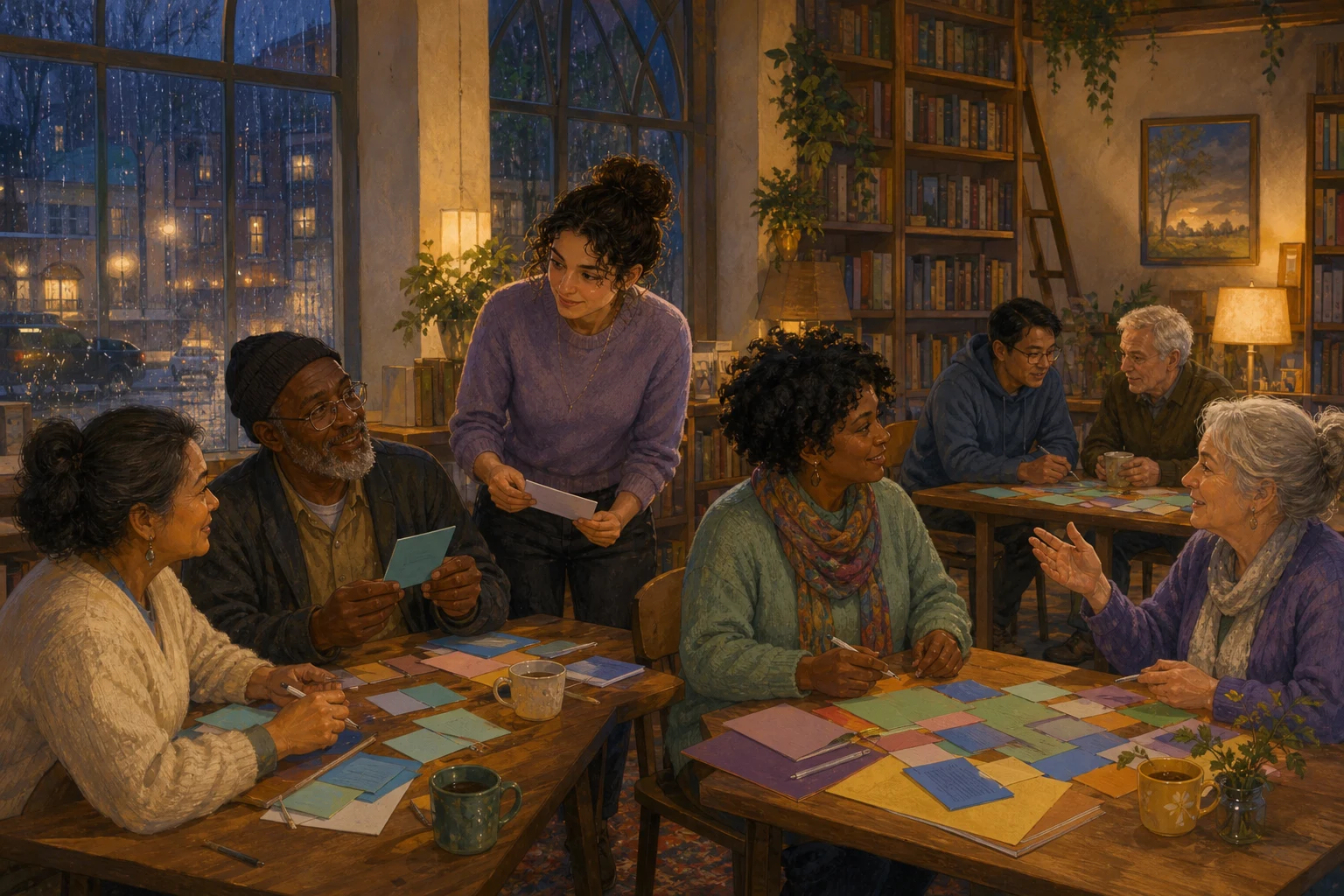
The next evening, she pushed the long table apart.
In its place she arranged four smaller tables, each with a stack of plain-language cards: “What is this asking?” “What proof do I already have?” “What should I record?” She wrote sample answers on colored paper and invented a role-play in which one person was a tenant, another a landlord, and a third a very stubborn envelope.
At first, the room was awkward. People kept looking toward Suri.
“Ask the card,” she said.
A graduate student read aloud, “What do I already have?” A tailor produced a rent receipt. Niko explained how to request a work letter. An older neighbor showed everyone how she kept copies in a labeled folder beneath her tea tin.
Suri walked between the tables, correcting only when necessary. The conversations grew louder. Someone laughed at the stubborn envelope. Someone else drew a map of the application website on the back of a library flyer.
Weeks later, Niko arrived early and took a seat beside a new bakery worker. When the worker held up a confusing form, Niko did not pass it to Suri. He turned the card around and asked, “What part feels unclear?”
Suri watched him explain the deadline, the documents, and the importance of keeping a copy. His answer was not perfect. It was better than perfect: it belonged to him.
Before closing, Suri added a new card to every table: “Who might know something I don’t?”
Then she left the tables facing one another, ready for the next evening’s questions.
Related Quote Stories

What the Broken Notes Were Saying
Daro had replaced the recorder’s cracked mouthpiece twice. It still squeaked like a startled pigeon. The child holding it knew why.
Read Story →
Light Through the Practice Glass
Belen trusted glass more than people. Glass showed every flaw immediately; people waited until later. Then a theater deadline forced her to choose between protecting her reputation and opening her work to others.
Read Story →
Where the Ground Remembers
When the community garden’s old map stops matching the shifting marsh soil, Yara discovers that the best plan is not a finished picture but a conversation that can keep changing.
Read Story →