
Quote Stories
Where the Water Leaves a Mark
A ferry clerk learns that the best map begins with listening.
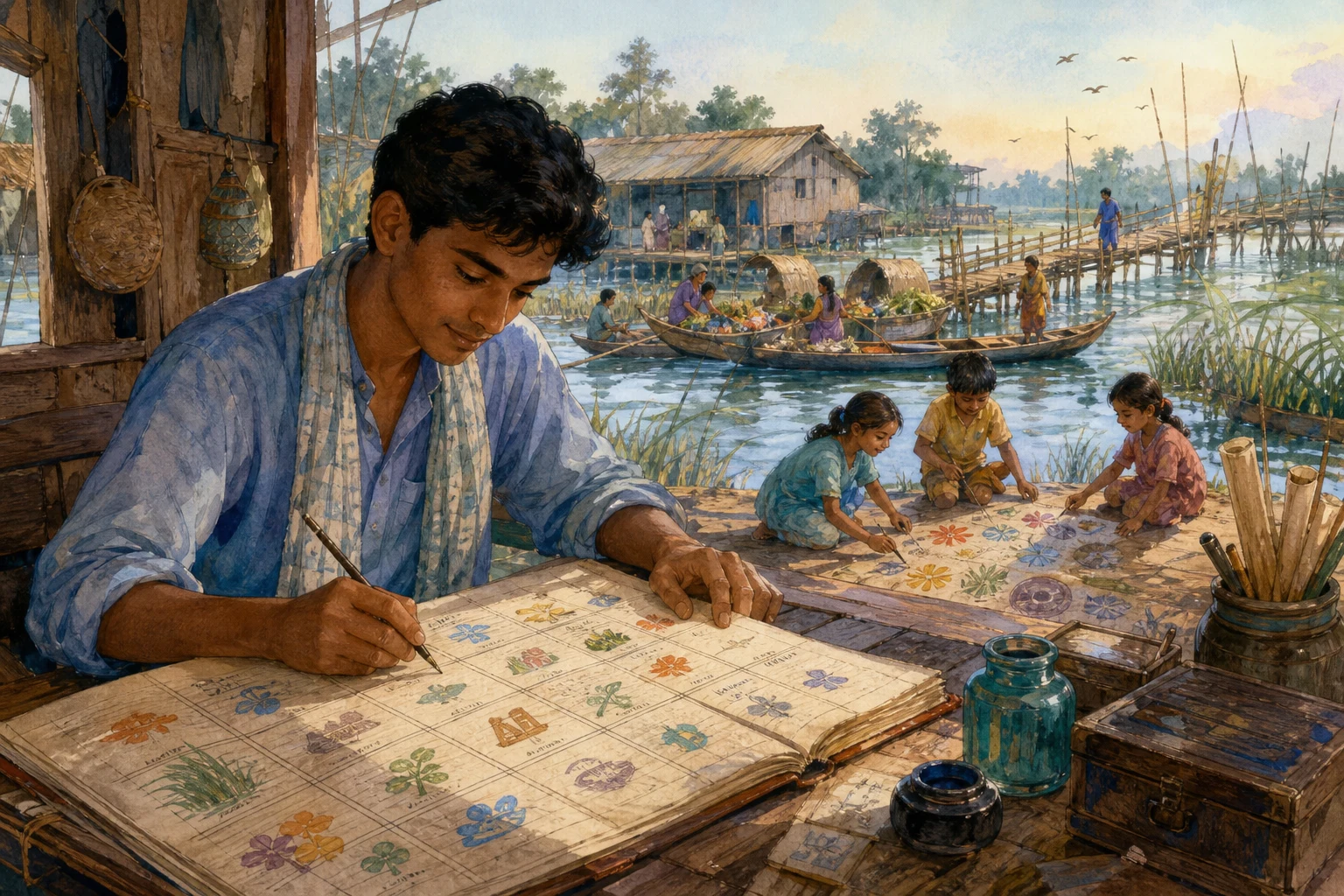
Anik’s ledger had three columns for every undelivered parcel: name, destination, and reason for failure.
He kept the notebook beneath the ferry counter, wrapped in oilcloth. The reasons were precise. Reed bridge submerged. Eastern channel narrowed. House relocated beyond the tamarind stump. Recipient away during low tide.
A month after he began the ledger, Anik drew a map.
He used a ruler, blue ink, and measurements taken from the ferry routes. He marked the settlements as neat squares and the channels as careful lines. At the top he wrote: CURRENT DELIVERY MAP.
By noon, everyone admired it.
By evening, three parcels had gone astray.
A bundle of schoolbooks meant for the reed-island classroom arrived at a boat builder’s shed. A packet of brass hinges meant for the western market traveled east. Most embarrassing of all, a wedding shawl was delivered to a family who had moved six weeks earlier—and whose new home stood less than a hundred steps from the old one, across a channel Anik had drawn as a thin blue curve.
The next morning, the shawl’s owner arrived at the ferry office with a smile that made Anik feel worse than anger would have.
“You drew the old water,” she said.
“The channel was there when I measured it.”
“It was,” she replied. “But the river does not sign agreements.”
Anik folded the map. “Then how do you find the house?”
She pointed toward the far bank. “I look for the leaning neem tree, the red canoe tied beneath it, and the roof with the blue clay pot. Ask anyone who lives there.”
Anik had spent weeks trying to make the river obey a page. He had not asked the people who crossed it every day.
That afternoon, he carried his notebook to the boat builders. They knew which bends became shallow after the rains and which sandbars appeared without warning. Instead of drawing lines, they suggested symbols: a pair of crossed oars for a reliable landing, three dots for a submerged path, a crescent for a channel that changed direction.
At the floating market, sellers added their own marks. A basket meant fresh produce nearby. A red stripe meant a loud bell hung at the dock. A small spiral showed where a boat could turn safely. Schoolchildren contributed symbols for landmarks visible from far away: a chimney, a painted wall, a clump of silver reeds.
Anik copied every suggestion into a new ledger. He tested each mark by showing it to someone who had not helped design it.
The first version still failed. A child’s silver-reed symbol looked too much like rain. The crossed oars were mistaken for a fish trap. One dock had three blue pots, not one, and the parcel carrier chose the wrong house.
This time, Anik did not defend the page. He brought it back to the people who used it.
They changed the symbols, added short descriptions, and left blank spaces for seasonal notes. Each settlement received a copy on thick, waxed paper. The master ledger stayed at the ferry office, open on a wooden stand where anyone could correct it.
Soon, the pages filled with useful details.
Books for the northern classroom: leave beside the bell post if the teacher is rowing.
Copper tools for the basket makers: use the landing with two flat stones.
Honey jars from the upper island: do not send during afternoon wind.
The ledger became less like Anik’s map and more like a conversation carried from shore to shore. Boat builders checked its channels. Market sellers updated its landmarks. Children noticed changes adults had overlooked and drew them in bright pencil.
One morning, a parcel arrived with no written address at all. It held a small wooden balance scale, packed in straw, and a note bearing only a spiral, two dots, and a yellow square.
Anik studied the marks. Then he opened the ledger.
The spiral meant the turning dock. Two dots marked the narrow crossing. The yellow square belonged to the schoolhouse on the island where children learned to count by weighing grain.
He smiled, tied the parcel securely, and carried it to the ferry.
At the next landing, a girl waiting beside the bell post recognized the symbols on the wrapping.
“For our classroom,” she said.
“For your classroom,” Anik agreed.
She took the parcel, then pointed to a blank corner on the ledger page. “The footbridge is back now. Should we draw it?”
Anik handed her the pencil.
The river shifted under the afternoon light, carrying silt, reeds, boats, and new paths toward places no ruler could predict. On the ferry counter, the ledger waited—not finished, but ready for the next person who knew where the water had left a mark.
Related Quote Stories

What the Hillside Knew
When her first planting failed, soil surveyor Amara traded certainty for questions—and found the hillside already had teachers.
Read Story →
Light Finds a Way
Beni wanted applause. What he found beneath the hall’s floorboards was something better: a way for many hands to make the evening shine.
Read Story →
Chalk After Closing
Leila’s first neighborhood board offered everything except certainty. To make it useful, she had to learn that sharing information also meant sharing responsibility.
Read Story →