
Quote Stories
Where Every Route Begins
Niko’s chalk map changes when he stops drawing for applause and starts observing how people move.

Niko’s blue chalk vanished beneath the wheels of a grocery cart.
He had drawn the route in looping arrows from the ferry stairs to the old warehouse where the after-school club met. It crossed a sunny courtyard, slipped beneath the bridge, and avoided every patch of broken pavement. At least, Niko thought it did.
“Can you move that line?” asked Ms. Irena, the crossing guard.
Niko looked up from his sketch. “Which one?”
“The one blocking the ramp.”
He glanced over his shoulder. A woman in a wheelchair had stopped at the edge of his maze. One of his thick chalk arrows ran straight across the ramp’s lowered entrance.
“Oh.” Niko rubbed at the mark with his sneaker. “I didn’t see it.”
“That’s why we test maps,” Ms. Irena said. “Not because the map is bad. Because the map is not the whole street.”
Niko was supposed to be designing the winning entry for his school’s city-planning prize. He had already imagined the certificate pinned above his desk. His maze had shortcuts, color codes, and a spiral underpass that looked, he thought, like a river turning into a dragon.
But the next afternoon, his map failed again.
His little brother, Olek, tried to follow the yellow route and got lost when a delivery van blocked the narrow lane. A neighbor carrying two shopping bags could not use the stairs Niko had marked as “fastest.” A girl from the club, Hana, pointed out that the afternoon sun made his orange arrows nearly invisible.
Niko’s face grew hot.
“I can fix it,” he said.
“You can watch it first,” Ms. Irena replied.
So he put away the chalk and carried a notebook.
For three days, Niko observed the streets at different hours. In the morning, fish sellers wheeled crates across the lane. At lunchtime, ferry passengers crowded the bridge. After school, younger children moved slowly, stopping to inspect bottle caps and painted stones. At dusk, the warehouse shadows stretched across the pavement, hiding cracks that were easy to see at noon.
He asked people where they preferred to walk and, more importantly, where they stopped.
The answers changed his map. Hana suggested marking smooth surfaces with a broad green line instead of using tiny symbols. Olek wanted pictures for children who could not yet read. The grocer showed Niko a route wide enough for a cart. Ms. Irena taught him to mark places where someone could pause without blocking others.
Niko redrew everything on a long roll of paper borrowed from the club. The map no longer looked like a dragon. It looked like a conversation: green paths, blue resting places, yellow crossings, and small drawings of ramps, benches, lights, and wide gates.
He made mistakes even then. One shortcut led through a courtyard whose gate was locked in the evening. Another passed a puddle that returned after every tide. This time, Niko did not defend the lines. He returned with an eraser, asked questions, and changed them.
On the day of the school prize, Niko carried the finished map beneath the bridge. Instead of presenting it alone, he invited the people who had tested it to stand beside him. Hana explained the symbols. Olek demonstrated the children’s picture key. The grocer rolled his cart along the broadest route, while Ms. Irena pointed out the safest crossing.
The judges liked the map, but they liked the testing notebook even more. It showed every change: the arrows moved, the colors darkened, the route widened, and one proud spiral disappeared entirely.
Niko did not win first prize. He received something called a special commendation, which sounded to him like a ribbon trying to be a sentence.
The useful part came later. Copies of the map appeared at the library, the laundry, the ferry shelter, and the club entrance. Each copy had a blank corner labeled: “What should we notice next?”
Niko kept a piece of blue chalk in his pocket. He still loved drawing mazes. Now, before he drew the first line, he looked around to see who might need a different way through.
Related Quote Stories
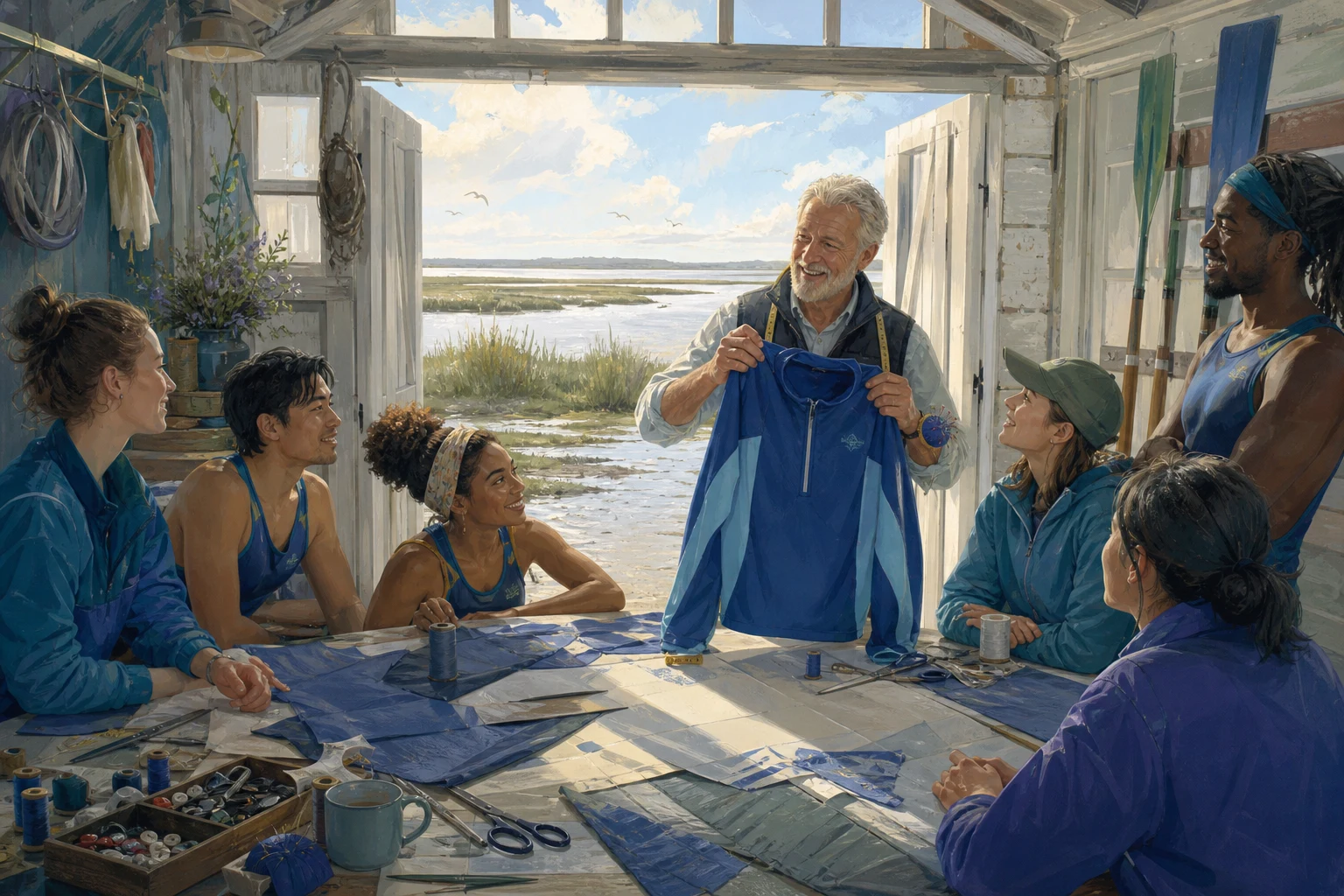
Room to Row
Dev had measured every rower by the same pattern. On the water, the pattern failed them. His answer began with a notebook, a bundle of surplus cloth, and the humility to watch before cutting again.
Read Story →
Monday Leaves Room
Ivo designed a courtyard no one could comfortably cross. Then he learned to let the garden change.
Read Story →
A Place for the Waiting
When ferry passengers begin competing for one sheltered bench, an apprentice sign painter discovers that the best public messages are sometimes built into the space itself.
Read Story →