
Quote Stories
What the Clay Kept
A potter discovers that a visible flaw can become an invitation.
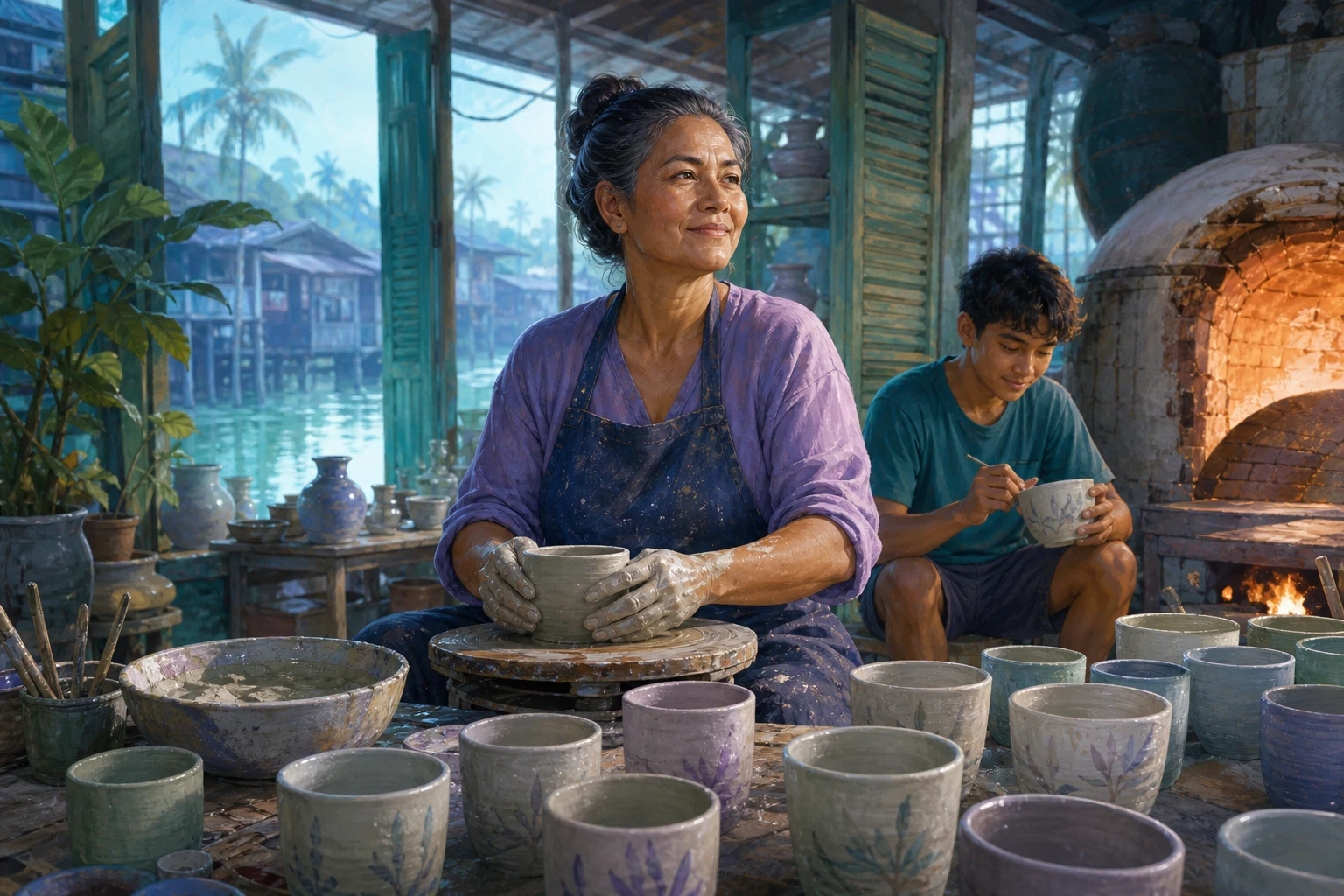
The kiln cracked at 3:17 on Saturday morning, just as the first pale light reached across the river and touched the workshop roof.
Irena heard the sound from her bed in the room above the clay yard: a sharp inward snap, followed by the low sigh of heat escaping. She was downstairs before the kiln finished cooling.
Inside, the cups waited in crooked rows. Some had split cleanly. Others wore thin brown lines that ran from rim to base. A few had survived, but their handles had slumped sideways like tired arms.
Irena counted them twice. The tea stall’s order was for three hundred cups, due before Sunday’s market opening. The deposit sat in a wooden box beneath her worktable. It was not enough to replace the clay, repair the kiln, and keep the workshop open another month.
Her nephew Niko arrived carrying two sesame buns and found her staring into the kiln.
“Are they all ruined?” he asked.
“Most of them.”
He picked up a cup with a branching line across its side. “This one looks like a river map.”
“It looks broken.”
“Those can be two things.”
Irena almost smiled, but the ledger on her desk was open to a page of unpaid bills. She had spent twenty-two years making cups that matched: even walls, smooth rims, identical blue glazes. A customer should be able to reach into a stack without finding surprises.
By noon, she had drafted a letter canceling the order. Before sealing it, she carried three cracked cups to the riverside tea stall.
The stall’s owner, Banu, turned each cup in her hands. So did the tea seller, the painter from the next courtyard, and two ferry workers waiting for ginger tea. Irena asked what they valued in a cup used every day.
“Strong enough for a crowded counter,” Banu said.
“Easy to recognize,” said the painter.
“Not too delicate,” said one ferry worker. “Our hands are wet half the morning.”
The other worker tapped the branching crack. “And if the mark tells me which cup is mine, that saves an argument.”
Irena returned to the workshop with a list, not an answer.
For three days, she tested the surviving cups. She sanded sharp edges, sealed the cracks with a dark food-safe glaze, and pressed a small clay mark into each base: a wave, a leaf, a star, a fish. She threw new cups with thicker walls and slightly different shapes. They were not identical, but they sat steadily and held heat.
Niko made a painted board for the stall: EVERY CUP HAS ITS OWN WEATHER.
Irena disliked the sentence until a customer read it aloud and chose a cup with a blue line curling beneath the rim.
“I want this one,” the customer said. “It looks as if it has been somewhere.”
The tea stall accepted the collection—two hundred and forty-seven cups for the opening, with the rest to follow. Banu paid the agreed price for every cup that passed the safety test. The imperfect pieces became the first to sell.
Still, the order alone would not save the workshop. Irena’s kiln needed rebuilding, and she could no longer afford to work as if every task belonged to her.
So on the following Thursday, she cleared the back room and placed six stools around a long table. Her first evening lesson was awkward. One student made a bowl too thin. Another used too much water. Irena corrected them sharply, then saw their hands withdraw from the clay.
She took a breath and placed her own cracked cup in the center of the table.
“This is what my hands made when they were certain they knew best,” she said. “Let’s see what we can learn from it.”
The students leaned closer.
By the end of the evening, they had made lopsided cups, a tiny dish, and one magnificent object no one could name. Each person paid what Irena had posted on the door. The money covered a delivery of clay.
Weeks later, the repaired kiln glowed behind the workshop. Shelves filled with sturdy cups, each one marked by hand. On Friday evenings, the back room filled with neighbors, ferry workers, young artists, and people who had never touched a wheel before.
Irena still made matching sets when customers asked for them. She simply no longer believed that sameness was the only proof of care.
At Sunday’s market, Niko lifted a cup marked with a crooked blue river. Steam rose from it into the humid morning.
“Still broken?” he asked.
Irena ran her thumb over the sealed line.
“Still carrying tea,” she said, and set another cup beside it.
Related Quote Stories
Ink Along the Waterway
Rina thought repainting the market lane meant making everything match. Then a missing blue heron sent three people the wrong way.
Read Story →
Sixty-Three Ways to Keep Time
Bela plans to close her sister’s clock shop, but a neighborhood exhibition—and a determined group of teenagers—gives her a reason to keep listening for what comes next.
Read Story →
A Sky Made of Many Tails
When every large kite collapses in the plateau wind, Tavi stops hiding the failures and invites younger builders to redesign the festival together.
Read Story →