
Quote Stories
A Map Made by Moving Feet
Sami learns that a welcome can be designed together.
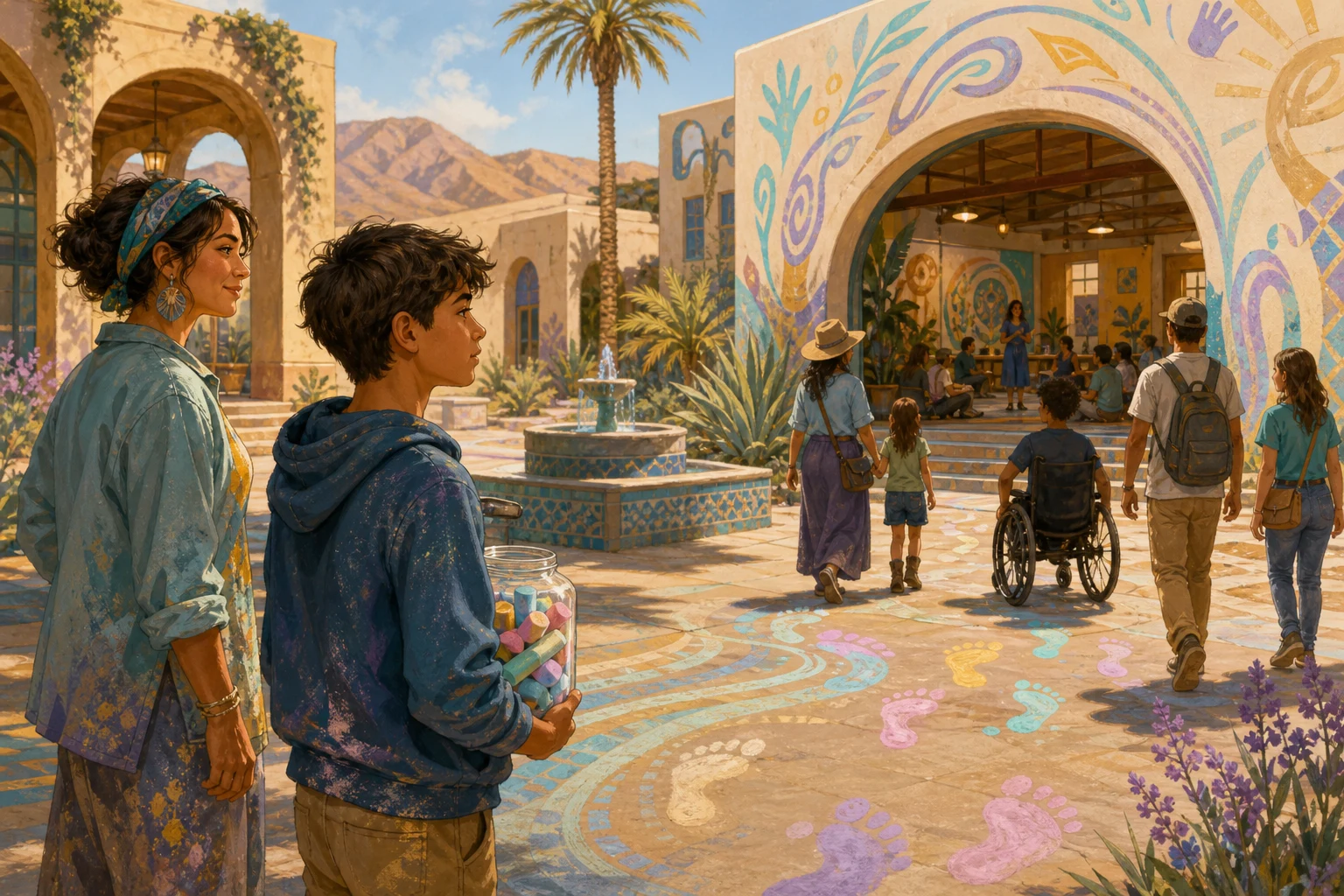
The wind arrived carrying half the plaza with it.
Sami lunged for the paper stencil, but it skittered beneath a date palm. Chalk dust burst from the open tin and swept across the wall in a pale yellow cloud. When the air cleared, the arrows he had spent all morning measuring had blurred into crooked streaks.
His aunt Leila stood beside the ladder, holding a brush dripping with blue paint.
“Don’t move,” she said.
“I’m not moving.”
“I meant the wall.”
Sami looked at his design. The first arrow pointed toward the fountain, the second toward the new learning center, and the third toward the courtyard classrooms. They had been identical in width and angle. Now they looked like startled birds flying in different directions.
Leila climbed down. “We can repaint it.”
“We have one afternoon.”
“Then we have one afternoon to decide whether the wall is the problem.”
Sami did not like questions that arrived disguised as advice. He gathered the chalk, swept the dust into a jar, and tried to redraw the central arrow. A delivery rider stopped, studied the wall, and wheeled his bicycle toward the wrong alley.
“Excuse me,” Sami called. “The center is the other way.”
The rider turned. “Then your arrow is pointing at a very convincing bakery.”
A pair of dancers soon crossed the plaza, following the same crooked mark. They spun around at the bakery, laughing. A parent carrying a sleepy toddler took the long route around the fountain. Two children ignored every arrow and followed the bright blue stripe Sami had painted as a border.
Sami opened his notebook.
“Could you try again?” he asked the dancers. “Don’t look at the wall first. Walk where you think the workshops are.”
They did. One dancer followed the shade. The other took the shortest path between two fountains.
A courier tested the route with his bicycle. A grandmother tested it while carrying a basket. The children tested it by running. Each person moved differently, and each revealed something Sami had missed: the afternoon sun made one corner too bright for small symbols; the fountain blocked a low arrow; people approaching from the market needed a sign before the steps, not after them.
Sami rubbed out the neat lines in his notebook.
“What if the path isn’t one arrow?” he asked Leila.
She handed him a piece of purple chalk. “What is it?”
“A set of invitations.”
By sunset, the wall had become a lively experiment. Oversized footprints crossed the plaza in three colors. A row of blue circles led toward music lessons. Orange handprints pointed to the repair tables. Green crescents marked the quiet reading room. Near the steps, Sami painted a wide band low enough for a child to see and high enough for someone pushing a cart.
He kept asking people to test it.
“Too small,” said the grandmother.
“Too high,” said the toddler’s parent.
“Make the footprints turn,” suggested the rider. “That way people know they’re meant to follow them.”
The dancers proposed a pair of yellow arcs that curved around the fountain like arms opening.
Sami painted them last. They were not symmetrical. One arc was longer because the fountain was off-center. The other leaned toward the shaded courtyard.
When the learning center opened, visitors arrived from every direction. Some followed the footprints. Some chose the colored bands. A child pressed both hands against the orange marks and announced that the repair tables were calling. Nobody asked Sami whether the mural was perfect.
Leila found him at the edge of the plaza, holding the jar of wind-scattered chalk.
“You saved it,” she said.
Sami watched a delivery rider follow the turning footprints without slowing. “No,” he said. “We found out where it wanted to go.”
The next morning, he added a blank square to the mural. Beside it he placed a small box of chalk, ready for the next person with an idea.
Related Quote Stories
What the Fire Left Behind
After a kiln ruins forty-eight bowls, Eren finds an unexpected use for every warped one—and a new reason to keep teaching.
Read Story →
When the Shadows Learned to Sing
A failing theater lantern sends Niko scrambling for a solution—and teaches him that the best performances are built with many hands.
Read Story →
Tide Lines
Hana wanted a place in the boat. Instead, she found a way to help everyone move together.
Read Story →