
Quote Stories
A Manual for the Moving World
Belen learns that a repair is strongest when more than one person knows how to make it.
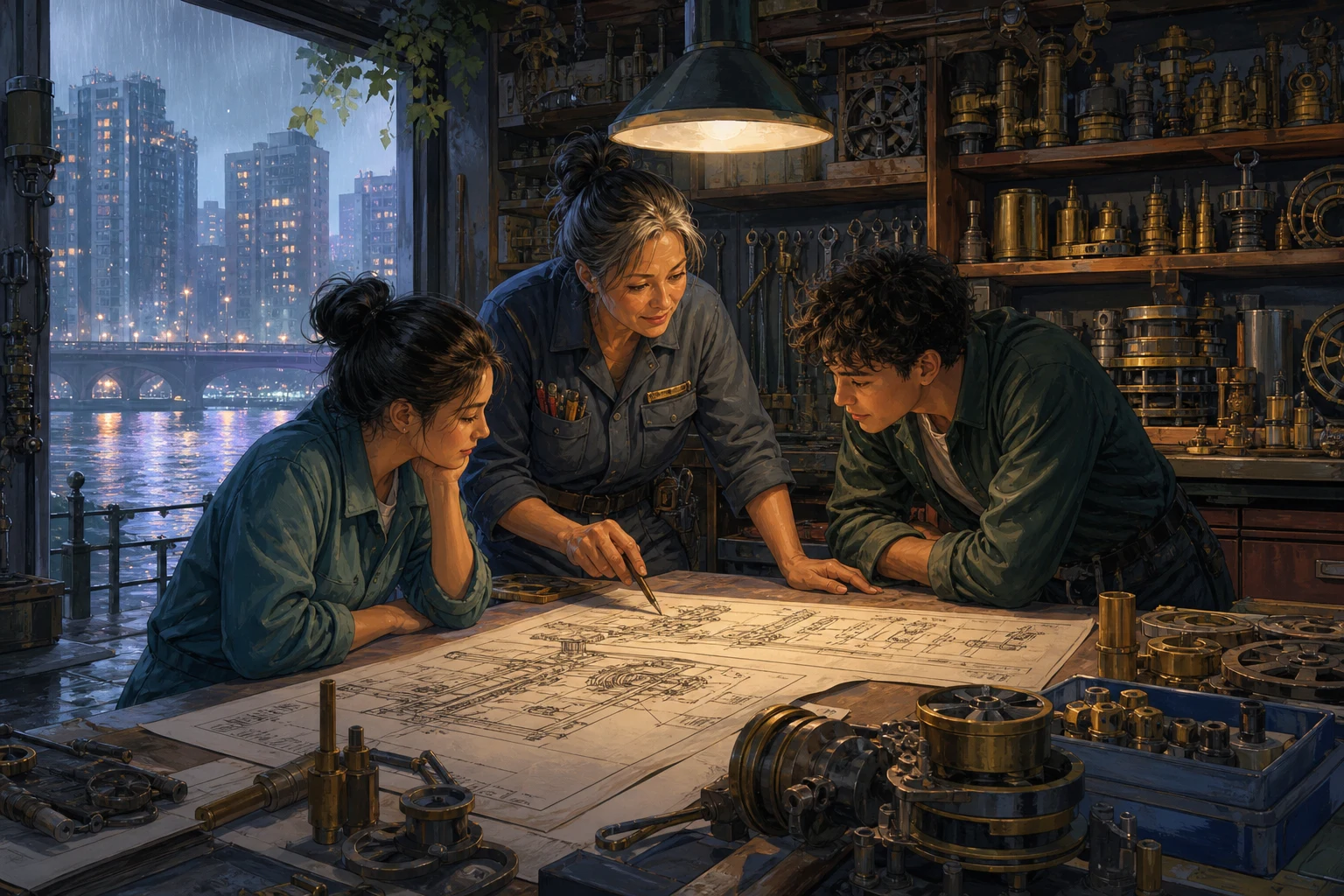
Belen could fix an elevator by listening to its silence.
A loose cable whispered behind the wall. A tired motor gave one extra shudder before stopping. A door that needed oil complained in a particular, offended creak. After thirty years in the repair shop beneath the river-port apartments, Belen knew every sound worth fearing—and most that were not.
Her apprentices, Tomás and Nuri, knew none of them.
“Again,” Belen said, as the test lift lurched between floors.
Tomás stared at the control panel. “I pressed the green button.”
“And the elevator has clearly taken that personally.”
Nuri hid a smile. Belen did not. She opened the service panel, adjusted a contact, and sent the lift smoothly downward.
The shop had begun receiving more calls than Belen could answer alone. Aging towers leaned over the waterfront, their covered stairwells smelling of rain and cooking oil. Residents carried laundry, groceries, bicycles, and sleeping children through buildings whose elevators had been repaired so many times that some seemed held together by habit.
Belen worked quickly. She also worked silently.
When she left Tomás and Nuri a task, she gave them the necessary tools and a look that meant they should already understand the rest. They tried. They guessed. They occasionally installed a perfectly good part in a perfectly wrong place.
Then, on a wet afternoon, the lift in Dockside House stopped with twelve residents inside.
Nobody was hurt, but the passengers waited nearly an hour while Tomás and Nuri searched for the fault. By the time Belen arrived, rain had darkened her coat and three residents were arguing in the lobby.
She listened to the motor, opened the panel, and found the problem: a worn relay that Tomás had inspected that morning.
His face fell. “I thought it was fine.”
“It looked fine,” Belen said. “That is not the same thing.”
On the walk back, she passed the apartments whose elevators she had repaired for years. She knew which residents avoided sudden stops, who needed room for a market cart, and which grandmother preferred to ride alone because crowded lifts made her anxious. She had gathered all that knowledge without writing down a word.
At the shop, Belen pulled a sheet of cardboard from a shelf.
“Tomorrow,” she said, “we are making instructions.”
Tomás looked alarmed. “For the relay?”
“For everything.”
They began with sketches. Nuri drew the elevator mechanisms from several angles. Tomás labeled parts in large letters. Belen recorded explanations on a small hand-held device, then stopped every few minutes to correct herself.
“No,” she said. “That is what I do. It is not yet what someone needs to know.”
The next morning, they invited residents from Dockside House to the workshop. Instead of asking only what had broken, Belen asked how people used the elevators.
A porter explained why the loading lift needed a slower closing speed. A nurse described how a sudden jolt affected patients moving between floors. Two children pointed out that the emergency instructions were too high for them to read.
Nuri added a bright strip of paint beneath the instruction panel. Tomás designed a simple checklist: listen, test, label, explain.
Belen objected to the last word.
“Explain comes before label,” she said.
“Why?” Tomás asked.
She looked at the crowded workbench, at the drawings spreading beneath the spare bolts and oil cans. “Because people should know what we changed in their building.”
Weeks passed. The manuals multiplied. Each one carried sketches, plain-language notes, and a small space for future repairs. The shop door stayed open during afternoon training sessions. Residents brought tea. Apprentices from other workshops came to copy the format. Even Belen began asking questions before reaching for her wrench.
Then an alarm sounded at a riverside tower while Belen was across the water repairing a freight lift. Tomás and Nuri arrived first.
The elevator had stopped unevenly, leaving its floor a few centimeters below the landing. Tomás read the guide aloud while Nuri checked the safety circuit. They called Belen once, not for instructions but to confirm their diagnosis.
“Good,” Belen said over the crackling phone. “Now tell me what you’ll teach the residents.”
When she reached the tower, the passengers were already out, calm and dry. Nuri had marked the worn component for replacement. Tomás was explaining the repair to a child who had been watching from the lobby.
Belen stood beneath the humming lift and listened.
The machine was not silent. It was working.
Back at the shop, she cleared a larger space on the wall. Tomás hung the newest manual there, with Nuri’s careful drawing on the cover.
Belen added one more line beneath the checklist: Leave the next person a way forward.
Then she handed them the keys for the morning call and kept the shop open behind them.
Related Quote Stories

Names for Every Turn
Lina’s first map was neat, confident, and wrong. Her second was crowded with fountains, fig trees, shortcuts, and the knowledge of everyone who called the hillside home.
Read Story →
Keep the Lane Open
Keo knows exactly how to win a race. He does not yet know how to keep a teammate from leaving one.
Read Story →
A Village Built from the Spill
Yara’s bridge falls apart just before the winter exhibition opens. What she builds afterward gives everyone a place in the design.
Read Story →