
Quote Stories
A Bell for Every Hollow
Tavi learns that useful sound does not need to be loud.
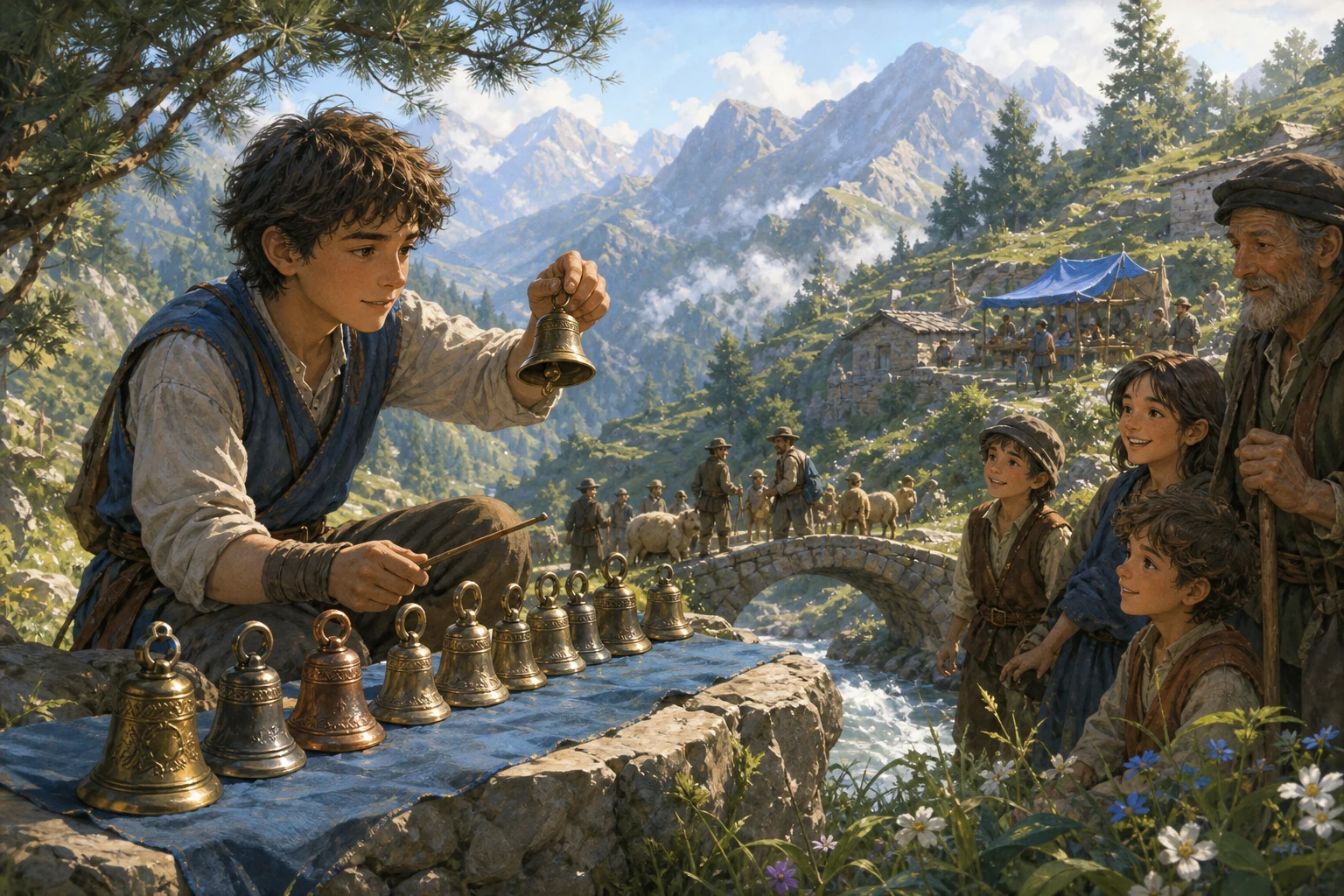
Tavi’s first bell could be heard from three valleys away. That was precisely the problem.
He struck it once outside the workshop, and the sound leapt across the terraces, bounced from the stone bridge, and returned in a trembling wave. The sheep scattered. A mule kicked at its tether. Even Tavi’s mother covered one ear.
“I made it carry,” he said.
“You made it shout,” said Mara, the shepherd who had brought the damaged bell. She watched her flock press together beneath an olive tree. “A bell is not judged by how far it troubles the mountain.”
The makers’ fair was four days away, and Tavi had imagined its judges lifting his bell beneath the striped awning, admiring its shine and thunder. He wanted his name written on the largest ribbon.
Instead, Mara led him up the western path.
At the first bend, she stopped and rang her old bell. Its note was low and warm. The sheep raised their heads but did not move.
“Now listen from there,” she said, pointing toward a narrow ravine.
Tavi crossed the footbridge and waited. The note arrived softened, as if wrapped in wool. He rang his own bell from the opposite slope. Its sharp cry ricocheted between the cliffs until he could no longer tell where it began.
“Every hollow carries sound differently,” Mara said. “And three families graze their flocks around this ridge. If every bell is loud, no one knows whose animals are calling.”
Tavi had studied metal, heat, and the careful shaping of a rim. He had not studied distance.
The next morning, he returned with charcoal, wire, and six small pieces of copper. He marked the paths on a scrap of packing paper: the open pasture, the pine hollow, the ravine, and the high shelf where sound vanished into the wind.
His younger cousins, Lio and Sena, followed him eagerly. They carried the bells and took turns walking away while Tavi recorded what they heard. At first, the trials became a game. Lio rang too early. Sena hid behind a boulder and answered with a goat’s bleat. Tavi lost his temper when they mixed up the notes.
Then Sena pointed to the map.
“You keep testing from the workshop,” she said. “But shepherds don’t stand there.”
Tavi looked at the paths. She was right.
They moved the tests into the hills. Mara brought two shepherd families, each with a different flock. The children stood at marked places and listened. Tavi changed the bells one by one: a narrower rim for a clear note, a small cut beneath the lip for a wavering tone, a heavier clapper for a sound that held close to the ground.
Nothing worked everywhere. A bell that carried beautifully through the pines disappeared near the high shelf. One that sounded gentle in the ravine became muddled across the open pasture.
So Tavi stopped trying to make one perfect bell.
He made a set.
On the morning of the fair, he arranged six modest bells on a blue cloth. None glittered like the great brass bell displayed beneath the main awning. None could be heard from the town square.
When the judges arrived, Tavi did not strike them in succession. He handed three bells to three shepherds and led everyone to the edge of the fairground, where the land fell away in folds.
The first bell answered from the pine path. The second came from the ravine. The third trembled across the open grass. Each sound was different, and each belonged to its place.
There was no grand ribbon for Tavi. The judges awarded the loudest bell to a craftsman from the northern road.
But before the fair ended, Mara unfolded Tavi’s marked map and pinned it beside the toolsellers’ stall. Shepherds gathered around it. They added their own paths, their own listening places, and notes about which tones traveled best.
By sunset, the map was covered in careful marks.
Tavi’s mother touched one of the small bells. “You could sell these,” she said.
“Perhaps,” Tavi replied. He looked toward the hills, where a quiet note rose from one pasture and another answered from beyond the trees. “But first we should test them where people use them.”
The next day, he brought a fresh sheet of paper to the workshop and drew the first line of a larger map.
Related Quote Stories
Ink for the Everyday
Sami’s grand stamp designs impressed nobody. Then three ordinary customers showed him what the shop was really for.
Read Story →
Wind Has a Way of Answering
After a crosswind tears apart her contest kite, Mara stops decorating and starts listening—to the wind, to an old weather watcher, and to the children whose kites fail beside hers.
Read Story →
Where the Water Turns
Dara’s boat flipped before it reached the second marker. By sunset, she had stopped trying to make it faster and started asking the tide better questions.
Read Story →